

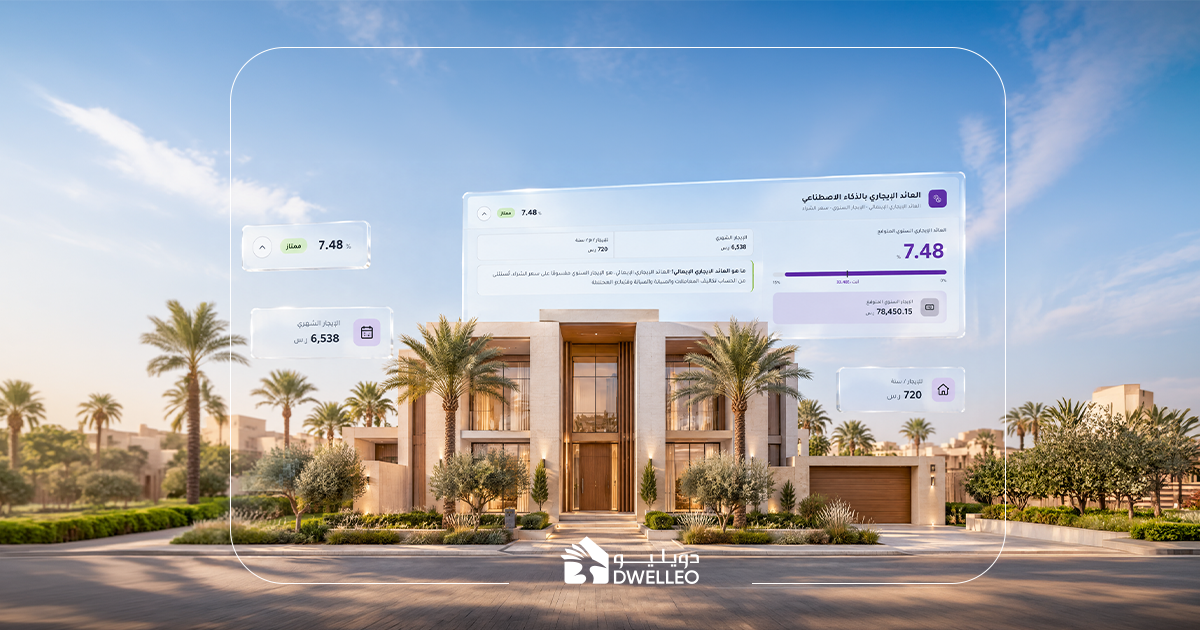
Real estate ROI, or Return on Investment, is a useful metric for understanding the relationship between the return generated by a property and the amount invested in it.
The purchase price or rental income alone does not tell the full story. A property may generate relatively high rental income, but its purchase price or operating costs may reduce the actual return. Another property may generate less rental income while producing a stronger return relative to the total investment.
ROI can therefore help investors:
- Compare different investment opportunities.
- Understand how property costs affect returns.
- Evaluate the relationship between invested capital and generated income.
- Build an initial view of an investment opportunity before making a decision.
However, ROI should not be considered on its own. Location, demand, occupancy, liquidity, market conditions, and investment risk also matter.
How Do You Calculate Real Estate ROI?
A simplified ROI formula is:
ROI = (Net Return ÷ Total Investment Cost) × 100
Net return refers to the amount remaining after relevant property expenses are deducted from the income generated by the property.
This is a simplified calculation for illustration and comparison. The actual ROI method can vary depending on financing, the type of return being measured, and the costs included in the analysis.
Example of Calculating Property ROI
Assume an investor purchases a property with a total investment cost of SAR 1,000,000.
The property generates SAR 70,000 in annual rental income, while annual property-related expenses amount to SAR 10,000.
Therefore:
- Annual rental income: SAR 70,000.
- Annual expenses: SAR 10,000.
- Net annual return: SAR 60,000.
- Total investment cost: SAR 1,000,000.
The simplified calculation is:
ROI = (60,000 ÷ 1,000,000) × 100 = 6%
Based on this simplified example, the property generates an annual return equal to 6% of the total investment cost.
What Is the Difference Between Rental Income and ROI?
Rental income is the amount collected from leasing a property over a specific period. ROI, on the other hand, relates the return to the amount invested.
A higher rental income does not necessarily mean a higher investment return.
For example, one property may generate SAR 100,000 in annual rental income but cost SAR 2.5 million, while another may generate SAR 80,000 but cost SAR 1.2 million.
That is why comparing return relative to investment cost can provide more insight than comparing rental income alone.
What Costs Should Be Included When Calculating ROI?
The more realistic the cost assumptions, the more useful the ROI calculation becomes.
Depending on the property and investment structure, costs may include:
- Property purchase cost.
- Maintenance and repair expenses.
- Property management fees.
- Renovation or preparation costs.
- Insurance where applicable.
- Relevant fees and obligations.
- Financing costs.
- Potential losses caused by vacancy periods.
Before comparing two properties, make sure you are using a consistent definition of total investment and net return.
What Is Rental Yield?
Rental yield focuses on the income generated by a rental property relative to its value or investment cost.
A simplified gross rental yield formula is:
Gross Rental Yield = Annual Rental Income ÷ Property Value × 100
Net rental yield also takes relevant expenses into account.
Gross yield can provide a quick initial view, while net yield can provide a better understanding of what remains after relevant costs.
When comparing two properties, use the same calculation method for both.
Does a Higher ROI Mean a Property Is a Better Investment?
Not necessarily.
A property may have a high ROI, but achieving that return could depend on optimistic assumptions about rental income, occupancy, or future property appreciation.
It is better to evaluate ROI alongside:
- Income stability: How sustainable is the expected income?
- Occupancy: Could the property experience periods without rental income?
- Liquidity: How easily could the property be sold?
- Location: How does the location affect demand?
- Market conditions: How are prices and demand changing?
- Risk: How much uncertainty is associated with the expected return?
- Investment horizon: How long does the investor plan to hold the property?
The question is therefore not only "What is the ROI?", but also "What assumptions are behind that ROI, and could they change?"
How Can You Use ROI to Compare Two Properties?
When comparing two investment opportunities, try to use a consistent calculation method.
Compare:
- Total investment cost.
- Expected income.
- Property expenses.
- Assumed occupancy.
- The period being analyzed.
You can then compare the resulting ROI percentages while also considering the differences between the properties.
A property with a higher ROI is not automatically the right choice for every investor because investment goals, risk tolerance, and liquidity requirements differ.
How Does Property Appreciation Affect Investment Returns?
Real estate returns can come from more than one source.
The first is rental income, while the second is the change in the property's value during the holding period.
An investor may receive rental income for several years and later sell the property at a higher price than the original purchase price.
A broader investment analysis may therefore consider:
- Rental income during the holding period.
- Property expenses.
- Changes in property value.
- Buying and selling costs.
- Holding period.
However, future property appreciation is not guaranteed. Any projection should therefore be treated as an estimate rather than a certain outcome.
What Is a Good Real Estate ROI?
There is no single ROI percentage that can be considered good for every property and every investor.
The appropriate return depends on:
- Property type.
- Location.
- Risk level.
- Financing and operating costs.
- Market conditions.
- Investment objective.
- Holding period.
When evaluating an ROI percentage, ask:
- Were expenses calculated realistically?
- Is the expected income sustainable?
- How does the return compare with similar properties?
- What level of risk is involved?
- Is the objective regular rental income or capital appreciation?
This makes ROI a tool for analysis and comparison rather than a final judgment on an investment.
How Can Dwelleo Help You Evaluate Real Estate Opportunities?
Beyond basic calculations, investors can use the analytical indicators available on Dwelleo property pages.
For example, current public property pages show an Investment Score, a composite indicator that considers factors such as value, income, location, and market saturation. Some property pages also display predicted annual rent and gross rental yield, providing additional context when evaluating an investment opportunity. Dwelleo
Some property pages also provide AI Price Prediction, allowing users to compare the property's current asking price with an AI-supported price assessment. Dwelleo
The key is not to look at ROI as an isolated number. Instead, consider it alongside the property's price, expected rental income, location, market competition, and other available indicators.
How Do I Calculate ROI on a Property?
A simplified calculation is to divide the property's net return by its total investment cost and multiply the result by 100.
ROI = (Net Return ÷ Total Investment Cost) × 100
Make sure your income, expenses, and assumptions are as realistic as possible.
What Is the Difference Between ROI and Rental Yield?
ROI measures the return relative to the investment, while rental yield focuses on rental income relative to the property's value or investment cost.
Does Mortgage Financing Affect Real Estate ROI?
Yes. The financing structure can affect the calculation, particularly when financing costs and the investor's actual capital contribution are included. The calculation method should therefore be defined before comparing investment opportunities.
Can You Rely on ROI Alone Before Buying a Property?
No. ROI helps with comparison and analysis, but it does not fully reflect location, demand, occupancy, liquidity, market risk, or changes in property value. A broader evaluation is recommended before making an investment decision.
Conclusion
Real estate ROI is a useful way to understand the relationship between the income generated by a property and the capital invested in it.
Its real value comes from using it as part of a broader investment analysis that considers expenses, occupancy, location, demand, liquidity, risk, and potential changes in property value.
Before making an investment decision, do not ask only "What is the return?" Ask also "How was it calculated, and how realistic are the assumptions behind it?"