

How do I know the value of my property? This is an important question that is not limited to a property owner preparing to sell their property, but also matters to a buyer who has found a suitable property and wants to know whether the asking price is reasonable before making a decision.
In the real estate market, the price shown in an advertisement does not necessarily represent the value of the property. Likewise, comparing a property with another property in the same neighborhood is not enough to reach a realistic estimate.
The value of a property is affected by a range of factors that begin with the location, area, and property type, and extend to its age, condition, features, and the prevailing prices of similar properties.
Therefore, the best way to understand the value is to first collect the property’s data, then compare it with the market, and make use of valuation tools that provide an initial estimate that can be used as a basis.
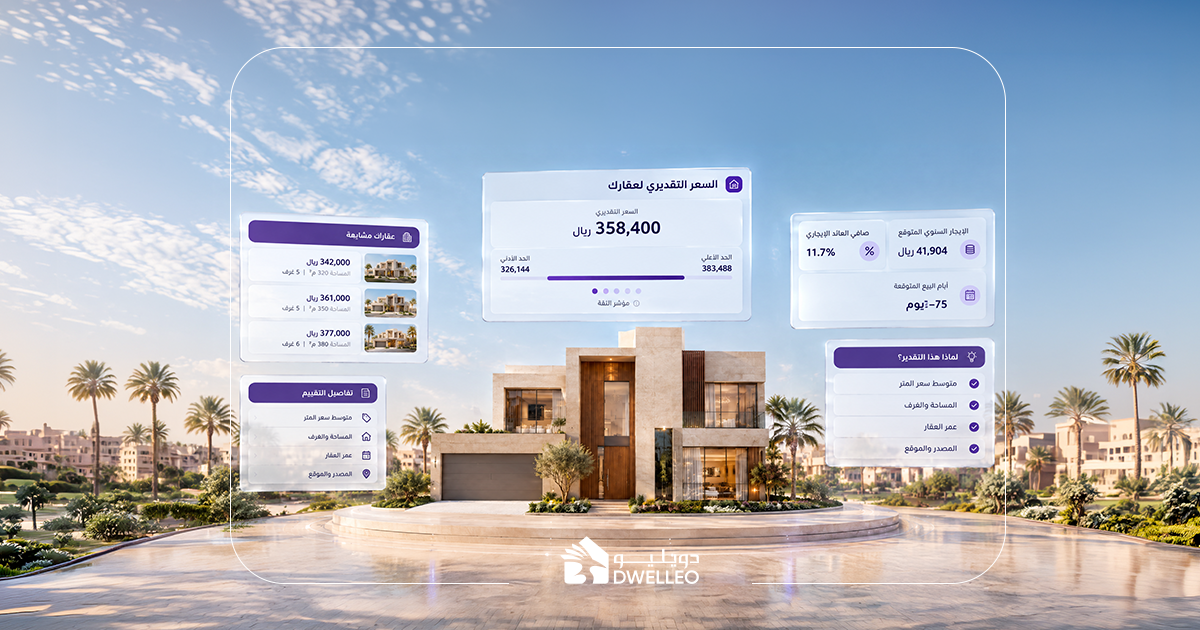
Dwelleo’s Estimate Your Property service helps you obtain an estimated range for the property’s value through simple steps, giving you an additional reference point before selling or buying.
In this guide, we explain in detail how a property is valued, what factors determine its value, how to compare prices correctly, and when you need an accredited real estate valuation.
What Is the Difference Between Property Value and Property Price?
Before searching for a way to value a property, it is important to understand the difference between value and price. They are not identical terms, and confusing them may cause an owner to set an unrealistic price or a buyer to pay an amount that does not correspond to the property.
The difference can be explained through four concepts:
- Estimated property value: An estimate of the property’s value based on its characteristics, data, and relevant market factors.
- Asking price: The amount chosen by the owner when listing the property for sale, which may be higher or lower than the estimated value.
- Actual sale price: The price at which the transaction is completed after the seller and buyer reach an agreement.
- Average prices in the area: An indicator that helps in understanding the surrounding market, but it does not mean that all properties in the area should be sold at the same price.
For this reason, you may find two apartments with similar areas in the same neighborhood, but one has a higher value because of the age of the building, the quality of the finishing, its location within the neighborhood, the view, parking spaces, or the available services.
How Do I Know the Value of My Property Correctly?
To know the value of your property in a way that is closer to reality, do not start by asking about the highest price reached by a property in your area. Start with the property itself, then move to the surrounding market.
You can follow these steps:
- Determine the property type: Apartment, villa, land, or another type, because the comparison should be made between similar properties.
- Determine the location accurately: Do not settle for the city name; the neighborhood and the location within the neighborhood may affect the value.
- Review the area: Compare your property with properties of similar sizes instead of comparing it with properties that are clearly larger or smaller.
- Record the property’s age and condition: A new or renovated property may differ from a property that requires maintenance, even if the area is the same.
- Identify the important features: Such as the number of rooms, parking spaces, frontage, floor, and view, depending on the type of property.
- Compare it with similar properties: Look for more than one property with similar characteristics instead of relying on a single listing.
- Use an estimated valuation: To obtain an additional reference point that helps you understand the range within which the property’s value may fall.
The idea here is that property valuation does not depend on one number, but rather on a set of data that must be considered together.
What Factors Increase or Decrease Property Value?
There are factors that an owner cannot easily change, such as the property’s location, and other factors that can be improved, such as the condition of the unit and its maintenance.
Understanding these elements is important because it explains why the average price per square meter alone is not enough to determine the value of your property.
The most important of these factors include:
- Location and neighborhood: The property’s proximity to roads, services, and facilities, as well as ease of access, may affect its attractiveness.
- Area and layout: The area is important, but how it is distributed and how efficiently it can be used are also important.
- Age of the building: Age affects the comparison, especially when there is a significant difference between properties.
- Condition and maintenance: The property’s current condition may affect the buyer’s willingness to pay the asking price.
- Unit specifications: The number of rooms, parking spaces, frontages, views, and other details may create a difference between two similar properties.
- Supply and demand: Higher demand for a particular area or type of property can affect prices.
- Market conditions: Property value is not a fixed number forever, so it is necessary to rely on information that reflects the market during the period in which the valuation is being conducted.
How Do I Compare My Property With Similar Properties?
Market comparison is one of the most useful steps, but its usefulness depends on choosing the right properties for comparison.
A common mistake is seeing a property in the same neighborhood and then using its price directly to determine the value of another property.
When selecting properties for comparison, try to ensure that they are similar in terms of:
- Property type.
- Neighborhood and location.
- Area.
- Age of the building.
- Number of rooms.
- Level of finishing and condition.
- Main features and facilities.
After that, do not look only at the total price. Try to understand the reason for the difference if the comparable property is more expensive. Ask: Is its area larger? Is it newer? Is its location better? Does it have additional features?
In this way, comparison becomes a tool for understanding the price rather than simply a way to search for a number that supports the price you already want.
Is the Price per Square Meter Enough to Value a Property?
The price per square meter is a useful indicator, but it is not enough on its own to determine the value of a property.
Using it alone implicitly assumes that every square meter in similar properties has the same value, while reality is more complex.
Therefore, use the price per square meter for an initial comparison, then review:
- How similar the properties used to calculate the price are.
- Differences in age and condition.
- The exact location of each property.
- Additional features.
- The date of the data used.
- Whether the figures represent asking prices or actual transaction prices.
The more similar the properties used in the comparison are to your property, the more useful the comparison result becomes.
How Does Dwelleo’s Estimate Your Property Service Help You?
If you do not know where to start, Dwelleo provides the Estimate Your Property service to obtain an initial estimate of the property’s value in a simple way.
Instead of relying on a personal expectation or moving between a large number of listings, you enter the required property data, and Dwelleo helps you form a clearer picture of its estimated value range.
The service benefits owners and buyers in different ways:
- For the owner: It helps them form an initial idea about the value of their property before determining the asking price.
- For the buyer: It helps them compare the asking price with the estimated value before making a purchase decision.
- For comparison: It provides a reference point that can be considered alongside the prices of similar properties.
- For negotiation: It gives both parties additional information that helps start the discussion about the price more clearly.
- For decision-making: It reduces reliance on guesswork alone when evaluating the price.
The result should be treated as an indicative estimated value, not as a guaranteed sale price or an official accredited real estate valuation.
How Do I Know If the Price of the Property I Want to Buy Is Suitable?
If you are a buyer, do not make your only question: Is the price within my budget?
The property may be within your budget, but its price may be high compared with its characteristics, or it may be more expensive than another property because of a genuine feature that justifies the price difference.
Before buying, review:
- The estimated value of the property.
- The price requested by the owner.
- Prices of similar properties.
- Differences that justify an increase or decrease in price.
- The condition of the property and potential maintenance costs.
- How well the location and specifications match your needs.
- Alternatives available within the same budget.
If there is a difference between the estimated value and the asking price, this does not automatically mean that the price is wrong, but it is a reason worth investigating and understanding before making a decision.
How Do I Set the Price of My Property If I Want to Sell?
After knowing the estimated range of the property’s value, the next stage is determining the asking price.
At this point, it is important not to make your desire to obtain the highest possible return the only factor in pricing.
Before setting the price:
- Know the estimated value of the property.
- Compare it with genuinely similar properties.
- Identify the strengths of your property.
- Pay attention to any defects or required maintenance work.
- Review market conditions and demand in the area.
- Determine your goal and how flexible you are in negotiations.
- Do not use the highest asking price in the area as your only reference.
Good pricing does not necessarily mean setting the lowest price. Rather, it means choosing a figure that you can explain and justify based on the property’s characteristics and the market.
What Mistakes Should Be Avoided When Valuing a Property?
Some valuation methods may seem logical at first, but they can provide a misleading impression of the price.
Before relying on any number, ask yourself about its source and how it was reached.
Common mistakes include:
- Relying on one person’s opinion.
- Pricing based on the owner’s financial needs.
- Choosing the highest listing in the neighborhood for comparison.
- Comparing properties that differ significantly.
- Treating every advertised price as an actual sale price.
- Ignoring the property’s condition and age.
- Relying only on the price per square meter.
- Using outdated data.
- Treating the estimated value as a guarantee of the final transaction price.
When Do I Need an Accredited Real Estate Valuation?
There is a difference between knowing the estimated value of a property for guidance and making an initial decision, and needing an official valuation report.
You may need an accredited real estate valuation when there is a transaction or an entity that requires an official report from an accredited valuer.
However, if your goal is to form an initial idea about the value of a property before selling, or to compare the price of a property before buying, you can start with digital valuation tools and market comparisons.
Therefore, before choosing a valuation method, first determine the purpose of the valuation: Do you want to know the price for guidance, or do you need an official document for a specific purpose?
If you are asking, “How do I know the value of my property?”, the answer does not start with the highest listing you find in the neighborhood, nor with a number you expect your property to be worth.
The best starting point is to know the property’s data accurately, then compare it with similar properties and understand the factors that increase or decrease its value.
For a buyer, it is not enough for the property to fit the budget. It is also important to understand whether the asking price corresponds to its characteristics and the surrounding market.
Use Dwelleo’s Estimate Your Property service as a starting point to help you know the estimated value of the property before selling or buying, so you can base your decision on clearer information instead of relying on guesswork alone.
FAQ
How Do I Know How Much My Property Is Worth?
Start by identifying the property’s data and specifications, then compare it with similar properties in terms of location, type, area, and condition. You can also use Dwelleo’s Estimate Your Property service to obtain an estimated value that helps you form an initial idea about the price.
How Is Property Value Calculated?
Property value does not depend on a single formula. Rather, it is affected by location, area, type, age, condition, specifications, supply and demand conditions, as well as data from similar properties.
Can I Know the Value of a Property Before Buying It?
Yes. You can compare the property with similar options, study the price and specifications, and use a valuation tool to obtain an estimated value that helps you assess the asking price before making a decision.
Is Online Property Valuation Accurate?
Online property valuation provides an indicative estimate based on the available and entered data. Therefore, it is useful as a reference point, not as a guarantee of the final sale price or an automatic substitute for an official valuation when one is required.