

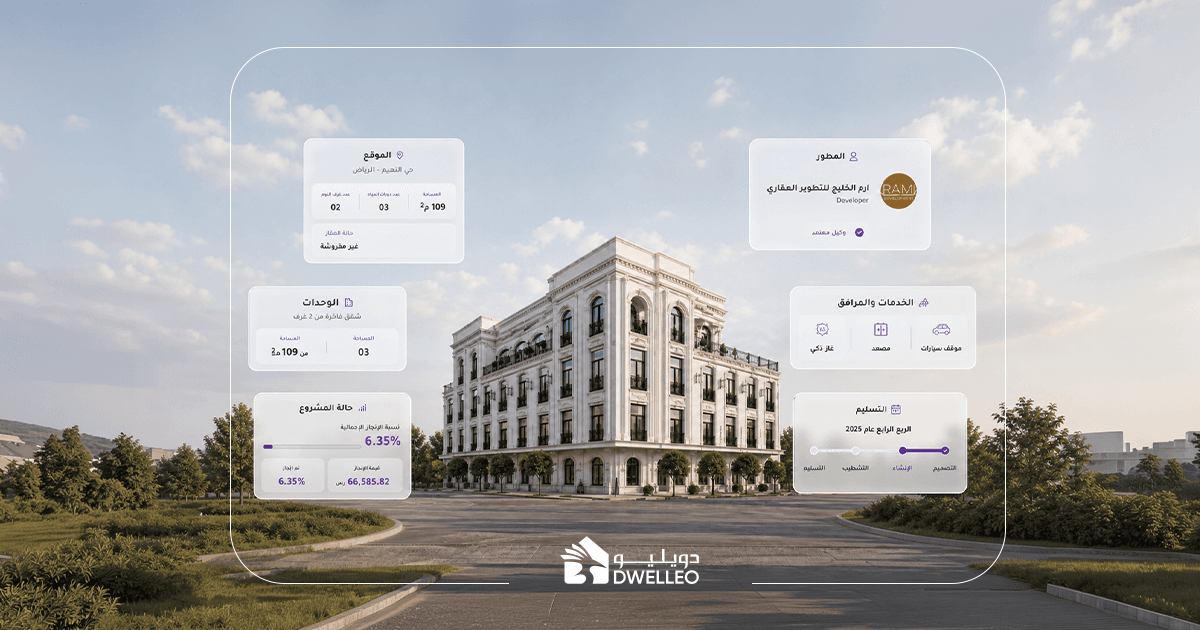
How do you evaluate a real estate project before buying a unit? This is an important question for anyone considering purchasing an apartment or villa in a residential development in Saudi Arabia. Projects can differ considerably in terms of developers, locations, prices, construction stages, and expected completion dates.
You may find a unit with an attractive design and a suitable price, but evaluating it requires more than reviewing its individual features. You also need to understand the development itself, including the developer's track record, construction progress, required licenses, available amenities, additional costs, and contractual obligations.
This is particularly important when buying an off-plan property, where the decision depends on approved specifications, project documentation, construction information, and contractual commitments rather than an inspection of a completed unit alone.
In this guide, we explore seven practical criteria to help you evaluate a real estate project, verify important information, and compare your options before making a purchase decision.
Why Should You Evaluate a Real Estate Project Before Buying a Unit?
Buying a residential unit is not just about choosing the right size or finding an attractive price. Your decision is also influenced by the project's construction quality, shared facilities, developer experience, and the clarity of its contractual terms.
Evaluating a project before buying can help you:
- Assess the developer: Understand the developer's experience and previous projects.
- Verify regulatory requirements: Check the relevant licenses and documentation based on the project type.
- Review construction progress: Understand the current development stage and its expected timeline.
- Compare available units: Evaluate differences in size, layout, location, and price.
- Estimate total ownership costs: Account for payment schedules, service charges, maintenance, and other expenses.
- Reduce purchasing risks: Identify missing information or contractual conditions that require clarification before signing.
Your evaluation will be more reliable when it is based on documented information and clear contractual terms rather than relying only on marketing images or verbal promises.
How to Evaluate a Real Estate Project Before Buying: 7 Essential Criteria
1. Check the Developer's Experience and Track Record
The developer is an important factor when evaluating a real estate project, especially if the property is still under construction. However, a company's reputation or the number of projects it has announced does not automatically establish construction quality or timely delivery.
When reviewing a developer, investigate the following:
- Previous projects the developer has completed or participated in.
- The status of those projects and whether units have been handed over.
- Construction and finishing quality in projects you can visit.
- The clarity and consistency of information provided to buyers.
- After-sales support, maintenance, and property management services.
- Reliable information about delivery timelines and compliance with agreed specifications.
Whenever possible, visit a previously completed project by the same developer. Observe the condition of shared facilities and buildings after they have been in use.
You can also explore real estate projects on Dwelleo to discover listed developments and the developers associated with them.
This information can help you form an initial assessment of a developer, but it does not replace independently verifying the project's licenses and official documentation.
2. Verify the Project's Licenses and Regulatory Status
Checking a project's regulatory status is an essential step before paying a reservation amount or signing a purchase agreement, particularly for off-plan developments.
In Saudi Arabia, the Real Estate General Authority (REGA) oversees the regulation of off-plan real estate sales and leasing through the Wafi program. Buyers should verify the licenses relevant to the project's type and stage rather than relying solely on the developer's assurances.
You can consult the official REGA Wafi Off-Plan Sales and Lease platform to review relevant information and services.
Before committing to a purchase, check the following as applicable:
- Whether the project and its sales or marketing activities have the required licenses.
- Whether the project name, location, and developer details match the available documentation.
- Whether the required permits and regulatory documents are available.
- Whether the unit's details, area, and specifications are clearly documented.
- Whether the purchase agreement and its attachments define the relevant rights and obligations.
- Whether payments are documented and handled according to the applicable project procedures.
For a completed development, also check ownership documents, the unit's status, and the applicable property-transfer requirements.
Do not assume that an online property listing proves that every regulatory requirement has been fulfilled. Listings are useful for discovering projects, while official verification should be completed through the relevant authorities and documentation.
3. Inspect the Project's Construction Status and Progress
The evaluation process differs depending on whether a project is ready for handover or still under construction. Each situation requires different checks.
For a completed project, inspect the unit and shared facilities, review finishing quality and available services, and identify any issues that may affect the property's condition or usability.
For an off-plan project, review:
- The current stage of construction.
- The reported completion percentage and whether it can be independently verified.
- The expected construction and handover schedule.
- Approved plans and specifications for the units and shared facilities.
- Which services have been completed and which remain under development.
- Licenses and required approvals relevant to the project.
Distinguish between marketing images, conceptual designs, and the actual construction status. Amenities shown in promotional materials are not necessarily completed or ready for use at handover.
Do not rely solely on a verbal completion date. Check the agreed handover date, property specifications, and relevant commitments in the applicable contractual documents.
4. Compare Residential Units Within the Project
A single development may offer apartments or villas with different sizes, layouts, locations, and prices. Even after selecting a project, you need to compare individual units to identify the most suitable option.
When comparing units, consider:
- The unit's area and the type of area measurement used.
- The number of rooms and the layout of interior spaces.
- Natural lighting, ventilation, and privacy.
- The unit's location within the building or development.
- Views and floor level, where relevant to your preferences or price.
- Parking availability and facilities assigned to the unit.
- Finishing quality and the features included in the asking price.
- Whether the contractual specifications match the advertised features.
Area alone does not determine which unit offers better value. Two units of similar size may differ considerably in layout, location, finishing, or included amenities.
How Do You Compare Unit Prices Within a Project?
Price per square meter can be a useful comparison indicator. Calculate it using the following formula:
Price per square meter = Total unit price ÷ Unit area in square meters
However, price alone does not determine which unit is better. Consider differences in floor level, views, location, finishing, and included features. Make sure that the same type of area measurement is used in each calculation.
For a more detailed explanation, read Dwelleo's guide to Average Price Per Square Meter in Real Estate: How to Read It and Compare Different Areas.
5. Review the Project's Amenities and Shared Facilities
Residential developments differ in the types of amenities they offer, how those facilities are maintained, when they become operational, and how much they cost to manage.
It is important to understand what you will actually receive for the price of the unit.
Depending on the development, review the following:
- Parking areas, entrances, and access routes.
- Elevators and shared facilities.
- Security and safety systems.
- Green spaces and walking areas.
- Recreational facilities, where available.
- Property management and maintenance services.
- Accessibility and movement within the development.
Do not assume that facilities shown in a master plan or advertisement will be available at handover. Verify their current status, expected opening dates, and whether they are included in the project's contractual commitments.
You should also ask about service charges, how they are calculated, who manages the shared facilities, and whether the owner will be responsible for recurring costs.
Two units with similar asking prices may have different long-term ownership costs because of differences in service charges or maintenance requirements.
6. Review the Contract, Payment Schedule, and Handover Date
The purchase agreement is one of the most important documents to review, especially when buying an off-plan unit. You should understand your financial and contractual obligations before signing, not after making substantial payments.
Review the following terms carefully:
- The total purchase price and payment method.
- Payment dates and the conditions attached to each installment.
- The contractual handover date.
- The agreed unit specifications, finishing, and shared facilities.
- The terms and procedures that apply if delivery is delayed.
- Cancellation and refund conditions under the contract and applicable regulations.
- Applicable warranties, including their scope and duration.
- Service charges, maintenance fees, and other additional costs.
- Inspection, handover, and defect-reporting procedures.
Make sure the information provided by the sales team matches the contractual documentation. If you identify a discrepancy or unclear provision, ask for written clarification before signing.
Consider consulting a qualified lawyer or relevant specialist when needed, particularly when the purchase involves an off-plan development or substantial long-term financial commitments.
7. Compare the Price With the Overall Value of the Project
A lower-priced unit is not necessarily the better option. Projects may differ in location, construction quality, amenities, service charges, and contractual commitments.
Compare the purchase price with what you will actually receive, including the additional costs associated with ownership.
Use the following table to compare two projects:
Comparison CriterionProject AProject B
A Practical Checklist for Comparing Two Real Estate Projects
When comparing two real estate projects, review the following criteria to identify their differences and determine which project best suits your needs and budget.
1. Total Unit Price
- Project A: —
- Project B: —
2. Unit Area
- Project A: —
- Project B: —
3. Location Suitability
- Project A: —
- Project B: —
4. Construction Status and Progress
- Project A: —
- Project B: —
5. Available Licenses and Documentation
- Project A: —
- Project B: —
6. Contractual Handover Date
- Project A: —
- Project B: —
7. Unit Quality and Specifications
- Project A: —
- Project B: —
8. Amenities and Shared Facilities
- Project A: —
- Project B: —
9. Service and Maintenance Charges
- Project A: —
- Project B: —
10. Contract Terms and Payment Schedule
- Project A: —
- Project B: —
Once you have completed the comparison, review the information you collected and identify the project that offers the best overall value and meets your requirements. Verify the relevant licenses, documentation, and contractual terms before making your final purchase decision.
Fill in the table using information you have verified. Then identify the criteria that matter most to your needs and budget.
If essential information is unavailable for one project, record it as something that requires further verification rather than assuming it represents an advantage or disadvantage.
This approach helps organize your decision, but it does not replace reviewing the contract, obtaining a technical inspection, or verifying the project's regulatory status.
How Do You Compare Real Estate Projects in Riyadh and Jeddah?
Real estate projects can differ by city, location, development type, and available services. For a more meaningful comparison, focus on projects with similar locations, unit types, and budgets rather than relying only on the price or developer's name.
Evaluating Real Estate Projects in Riyadh
When evaluating a project in Riyadh, start by reviewing its location in relation to your workplace, schools, essential services, and major roads.
Then compare it with similar developments in the same area, focusing on unit sizes, prices, finishing quality, shared facilities, construction status, and expected handover dates.
It is also useful to assess actual commuting times and project-related charges so that your decision is not based on the asking price alone.
Explore real estate projects on Dwelleo to discover available options in Riyadh and compare developments that match your requirements.
Evaluating Real Estate Projects in Jeddah
When comparing projects in Jeddah, review accessibility, nearby services, road conditions, infrastructure, and shared amenities.
Depending on the specific location, it may also be important to check drainage conditions and local infrastructure using official information and an on-site visit.
Next, compare prices, specifications, service charges, construction stages, and handover dates across projects with similar locations and property types.
Do not assume that projects within the same neighborhood offer equivalent value or quality. Units, amenities, contractual terms, and costs can differ even between developments in the same area.
What Are the Common Mistakes to Avoid When Buying a Unit in a Real Estate Project?
Focusing only on marketing advantages can cause buyers to overlook details that affect ownership costs and the overall buying experience.
Common mistakes include:
- Relying only on promotional images and designs: Without verifying approved specifications and actual construction progress.
- Failing to assess the developer: Relying solely on the developer's reputation or the number of announced projects.
- Ignoring licenses and documentation: Or postponing their review until after reaching an agreement.
- Overlooking contract details: Especially payment terms, handover conditions, cancellation rules, and warranties.
- Ignoring service and maintenance charges: Focusing only on the unit's purchase price.
- Overestimating future promises: Without verifying the status of proposed developments and services.
- Comparing prices without accounting for differences: Failing to consider unit sizes, locations, or specifications.
- Paying a reservation amount too quickly: Without understanding the reservation terms, required documents, and any applicable refund conditions.
To avoid these mistakes, collect the relevant information, retain written offers and documents, and verify regulatory and contractual details before committing to the purchase.
How Can Dwelleo Help You Evaluate Real Estate Projects?
Dwelleo helps you explore real estate projects and review the information available about developments, developers, and listed units. This information can serve as a starting point for organizing your research and identifying projects worth comparing.
Useful features include:
- Real Estate Project Listings: Explore available projects and review the information provided about each development.
- Developer Information: Discover developers associated with projects listed on the platform.
- Search and Filters: Narrow your options by location, project, developer, and relevant property criteria.
- Average Price Per Square Meter: Compare price levels across similar units and areas.
- Market Information: Review available market data and indicators to support your research.
Start with Dwelleo's Real Estate Projects to explore developments in Riyadh, Jeddah, and other cities, then compare the options that fit your budget and requirements.
Remember that a project's presence on a real estate platform does not replace checking its licenses, official documents, or contractual terms. Use platform information to organize your search, then verify important regulatory matters with the relevant authorities before buying.
Frequently Asked Questions About Evaluating a Real Estate Project
How Can I Tell Whether a Real Estate Project Is Reliable?
Start by reviewing the developer's track record and previous projects. Then verify the relevant project licenses and documentation, review construction progress, and examine the contract terms. For off-plan developments in Saudi Arabia, use the appropriate official channels to check the project's regulatory status.
Is Buying an Off-Plan Property Better Than Buying a Ready Property?
It depends on your budget, requirements, and willingness to wait. A ready property allows you to inspect the actual unit and facilities before buying. An off-plan property requires additional attention to licensing, construction timelines, approved specifications, payment terms, and the purchase agreement.
What Should I Review Before Signing a Property Purchase Agreement?
Review the unit details and specifications, total price, payment schedule, handover date, delay and cancellation terms, warranties, service charges, and relevant regulatory documentation. Consult a qualified specialist if you encounter unclear provisions or significant financial commitments.
How Can I Verify an Off-Plan Real Estate Project in Saudi Arabia?
Consult the official REGA Wafi Off-Plan Sales and Lease platform. Check the relevant license, project details, and required documents before paying any amounts or signing an agreement.
Does a Lower-Priced Unit Mean the Project Is Better?
Not necessarily. A lower price may reflect differences in location, size, specifications, amenities, or payment terms. Compare the overall cost and the value offered by the project, and verify the relevant information before choosing a unit.
Evaluate Your Real Estate Project Before Buying With Dwelleo
Evaluating a real estate project involves more than choosing a suitable unit. It requires reviewing the developer, location, construction quality, amenities, documentation, handover terms, and total ownership costs.
The more your decision is based on clear information and independent verification, the better prepared you will be to understand the differences between projects and select an option that suits your needs and budget.
Start with Dwelleo's Real Estate Projects, explore available developments, compare the options that interest you, and verify the relevant licenses, documents, and contract terms before making your purchase decision.