

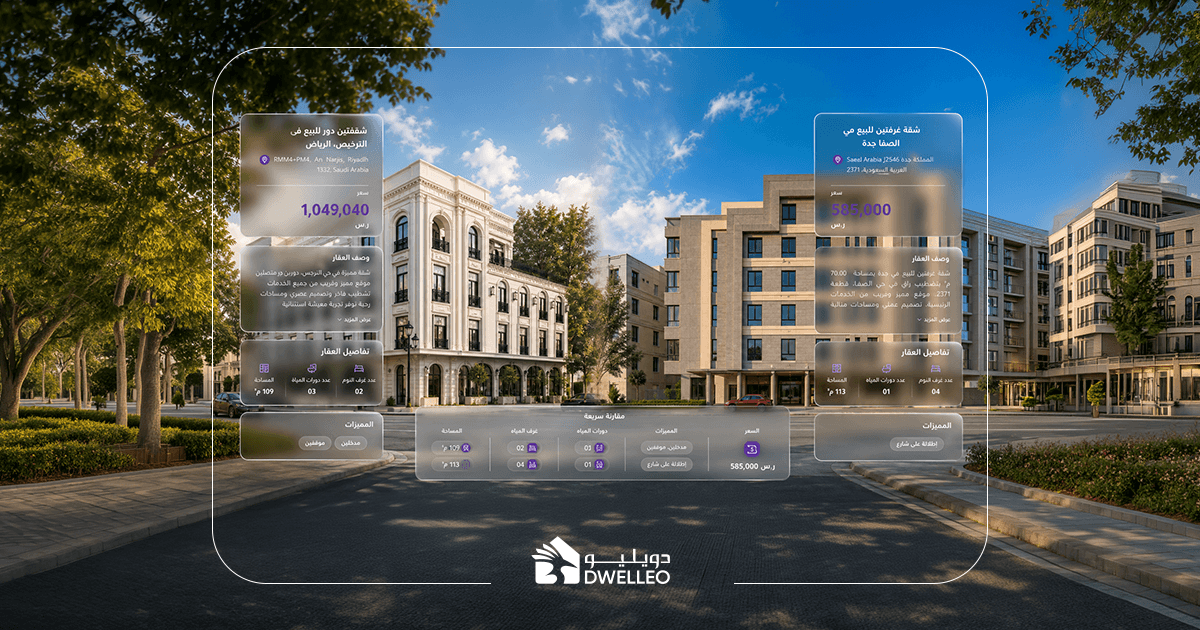
How do you compare properties before buying? It is an important question for anyone looking for a home or an investment opportunity in Saudi Arabia. With so many properties available at different prices, sizes, and locations, choosing the option that offers the best value can be challenging.
You may find two properties at a similar price, but one offers a more convenient location close to essential services, while the other provides more space or a better layout. A property with a lower asking price may also involve higher long-term costs because of repairs, maintenance, or additional finishing work.
That is why comparing properties involves more than looking at the asking price. You should also consider location, size, layout, condition, total ownership costs, and how well each property matches your goals.
In this guide, we explore seven practical steps to help you compare properties objectively, evaluate your options, and make a more informed buying decision.
Why Is It Important to Compare Properties Before Buying?
Comparing properties helps you understand the differences between available options and determine what you are getting for your money. The lowest-priced property is not necessarily the best choice, just as a higher price does not automatically guarantee better quality or stronger investment potential.
The main benefits of comparing properties include:
- Evaluating value for money: Determine whether a property's features and advantages justify its asking price.
- Choosing the right property: Identify the option that best meets your residential or investment needs.
- Estimating total costs: Account for purchase-related expenses, furnishing, repairs, and maintenance.
- Understanding differences between options: Compare size, layout, location, and property condition more accurately.
- Reducing decision-making risks: Avoid rushing into a purchase that does not fit your budget or long-term requirements.
The comparison process becomes more effective when you establish your priorities in advance and use the same criteria to evaluate every property.
How to Compare Properties Before Buying: 7 Essential Steps
1. Define Your Budget and Property Goals
Before starting your search, decide whether you are buying a property to live in or as an investment. Your objective will influence which factors deserve the most attention.
If you are buying a family home, you may prioritize the number of bedrooms, layout, proximity to schools and essential services, and convenient daily travel.
If your goal is investment, you may need to focus more on rental demand, expected rental income from comparable properties, operating and maintenance costs, and potential resale demand.
Your budget should also cover more than the purchase price. Allow for applicable transaction fees, financing or brokerage costs where relevant, and any expected finishing or repair expenses.
Defining your budget and goals from the beginning helps you eliminate unsuitable options and focus on properties worth comparing.
2. Compare Property Locations and Their Suitability for Your Needs
Location affects everyday convenience and may influence a property's appeal to future buyers or tenants. At this stage, you do not need to conduct an exhaustive neighborhood analysis. Focus on whether each location meets your main priorities.
When comparing locations, consider:
- Travel distance and time to work or other important destinations.
- Availability of essential services.
- Access to major roads.
- Traffic congestion and noise levels.
- The condition of local infrastructure and available services.
- Whether the surrounding area suits your residential or investment objectives.
Whenever possible, visit each property at different times of day. Traffic, noise, and neighborhood activity can vary considerably depending on the time.
The best location is not necessarily the same for every buyer. One person may prioritize proximity to work, while another may prefer a quieter environment, a larger property, or a lower purchase price.
3. Calculate the Price Per Square Meter
Price per square meter is a useful indicator when comparing properties with different sizes and asking prices. However, it should not be used as the only measure of value.
You can calculate it using the following formula:
Price per square meter = Total property price ÷ Property area in square meters
For example:
- Property A: A price of SAR 900,000 and an area of 150 m² result in a price of SAR 6,000 per m².
- Property B: A price of SAR 1,000,000 and an area of 200 m² result in a price of SAR 5,000 per m².
Although Property B has a higher total price, its price per square meter is lower. However, that does not automatically make it the better choice. The properties may differ in location, building age, finishing quality, condition, or layout.
For a fair comparison, focus on properties that are reasonably similar in type, location, condition, and features. Also, make sure you are comparing the same type of area measurement.
To understand this metric in more detail, read Dwelleo's guide to Average Price Per Square Meter in Real Estate: How to Read It and Compare Different Areas.
4. Compare Property Size and Layout
The total area alone does not tell you how practical a property will be. A smaller unit may offer a more functional layout, while a larger one may contain space that is difficult to use effectively.
When comparing apartments or villas, pay attention to:
- The number and size of bedrooms.
- The arrangement of living areas and facilities.
- Natural lighting and ventilation.
- Privacy between rooms and shared spaces.
- Parking and outdoor areas, where relevant.
- How easily furniture can be arranged.
- Whether the layout meets your current and future needs.
You should also confirm which area measurement is being advertised, such as total or net usable area, before comparing different properties.
Choose the layout that makes the best use of space for your needs rather than focusing on square meters alone.
5. Inspect the Property's Condition and Building Age
A property's physical condition can affect maintenance expenses, comfort, and the quality of daily use after purchase. For this reason, attractive finishes or a good first impression should not be the only basis for your evaluation.
Before making a decision, check the condition of:
- Walls and ceilings for visible signs of damage.
- Electrical, water, and drainage systems.
- Doors, windows, and insulation.
- Shared facilities and building amenities.
- Elevators and parking areas, where applicable.
- Previous maintenance work and known repairs.
- Available warranties and their terms, if any.
Find out how old the building is and whether significant maintenance work may be required soon. For a resale property, or whenever you notice potential issues, consider hiring a qualified professional to conduct a technical inspection.
You should also verify ownership information and relevant legal documentation before committing to the purchase. A property's physical condition and its legal status are both important parts of the buying decision.
6. Compare Total Ownership Costs, Not Just the Asking Price
A property may appear cheaper initially but require repairs or finishing work that makes its final cost higher than that of another property.
For this reason, estimate the total cost of each option. Depending on the transaction, this may include:
- The property purchase price.
- Applicable taxes and statutory fees.
- Financing and brokerage costs, where relevant.
- Finishing, furnishing, and repair expenses.
- Recurring service charges and maintenance costs.
- Other operating expenses associated with the property.
For example, suppose Property A costs SAR 950,000 and requires SAR 80,000 in repairs. Its cost reaches SAR 1,030,000 before any other applicable expenses.
Property B may cost SAR 1,000,000 but require only limited preparation. In this case, Property B could have a lower total cost despite its higher asking price.
This example is illustrative. Your actual costs will depend on the property's condition and the expenses applicable to your purchase.
7. Rank Properties Based on Your Priorities
After collecting the information, organize the properties from the most suitable to the least suitable. One practical approach is to use a comparison table and score each criterion on a scale of 1 to 5.
Start by deciding how important each factor is to your goal. If you are buying a family home, you might give greater importance to location, layout, and nearby services. If you are buying for investment, total cost, rental demand, and potential returns may carry more weight.
Use the following table to organize your findings:
Comparison CriteriaProperty AProperty B
Total purchase price | — | —
Property area in m² | — | —
Price per m² | — | —
Location suitability | — | —
Services and accessibility | — | —
Layout and use of space | — | —
Physical condition and maintenance | — | —
Additional costs | — | —
Suitability for your buying goal | — | —
Once you complete the table, assign a score from 1 to 5 for each criterion according to how well the property meets your needs. Then compare the results, giving greater importance to the factors that matter most to you.
This method helps you organize information and identify differences between options. However, it is a personal decision-making tool, not a formal property valuation, and it does not replace a technical inspection or legal verification.
How Does Property Comparison Differ Between Riyadh and Jeddah?
Your priorities may vary depending on the city, neighborhood, and type of property. It is therefore useful to apply the same comparison criteria while considering local infrastructure, available services, and accessibility.
Comparing Properties in Riyadh
When searching for properties for sale in Riyadh, focus on travel times between neighborhoods, access to workplaces and essential services, and the availability of suitable roads and public transportation.
Compare similar properties within the same neighborhood whenever possible. Differences in layout, building age, condition, and the availability of services may help explain variations in asking prices.
You can start with Dwelleo's property listings, use the search filters to narrow your options by city, property type, and price range, and then compare the properties that match your requirements.
Comparing Properties in Jeddah
When comparing properties in Jeddah, consider access to essential services and workplaces, road conditions, commuting times, building age, and maintenance requirements.
It is also worth checking the condition of local infrastructure and drainage in the specific area, rather than relying entirely on the information provided in a property listing.
After identifying suitable neighborhoods, compare properties with similar types, sizes, and conditions. Do not rely on the neighborhood's average asking price alone to determine which property offers the best value.
You can use Dwelleo to explore available properties and narrow your search by location, property type, and budget.
What Are the Common Mistakes to Avoid When Comparing Properties?
Focusing on a single advantage may lead you to choose a property that does not meet your needs or budget. Common mistakes include:
- Looking only at the total price: Without calculating the price per square meter or considering additional expenses.
- Comparing dissimilar properties: Without accounting for differences in type, location, size, and condition.
- Ignoring maintenance requirements: Which may increase costs after purchase.
- Relying only on listing photos: Without visiting the property and verifying key details.
- Focusing on size alone: Without assessing the layout and how effectively the space can be used.
- Neglecting legal documentation: Or postponing the verification process until after reaching an agreement.
- Making a decision based on first impressions: Instead of collecting information and reviewing the available options systematically.
To avoid these mistakes, use a consistent comparison table, gather information from reliable sources, and do not make a final decision before inspecting the property and checking the relevant details.
How Can Dwelleo Help You Compare Properties Before Buying?
Dwelleo can help you organize your property search and review the information available about different options. Instead of relying on asking prices alone, you can use property search tools and market data to support your evaluation.
Depending on the property and the data available, useful features may include:
- Property search and smart filters: Narrow your search by city, property type, price range, and other relevant features.
- Market Insights: Explore available market information, price indicators, and trends.
- Estimate Your Property: Obtain an indicative property value estimate where the service is available and applicable.
- Price-per-square-meter data: Compare price levels across similar properties and locations.
- Lifestyle Score: Review indicators related to the surrounding environment and amenities, where available.
- Investment Score: Consider available investment-related indicators when comparing properties.
You can visit Dwelleo Properties to explore listings. You can also visit Dwelleo Market Insights to review available information and indicators relating to the Saudi real estate market.
Remember that estimates and indicators are supporting tools, not guarantees of a property's value or future investment returns. Combine the available data with an on-site inspection, technical checks, and verification of legal documentation before completing your purchase.
Frequently Asked Questions About Comparing Properties Before Buying
How Do I Compare Two Properties With the Same Asking Price?
Compare their size, price per square meter, location, layout, physical condition, nearby services, and additional costs. Then determine which property offers better value for your needs and buying goals rather than relying on price alone.
Is Price Per Square Meter More Important Than the Total Property Price?
Price per square meter is a useful comparison indicator, but it is not sufficient on its own. You should also consider the total purchase price, location, layout, physical condition, and additional ownership costs, ideally comparing properties with similar characteristics.
What Is the Most Important Step Before Buying a Property?
No single step is sufficient on its own. It is important to inspect the property, assess its physical condition, verify ownership information and relevant legal documentation, and review the total cost to determine whether it fits your needs and budget.
Is the Cheapest Property Always the Best Choice?
No. A lower-priced property may require expensive repairs or offer less suitability for your needs. Compare the total cost, features, location, and physical condition to determine which option provides the best value for your circumstances.
Compare Properties and Make an Informed Decision With Dwelleo
Choosing the right property is not simply about finding the lowest price or the largest space. It means balancing location, layout, physical condition, total ownership costs, and how well the property meets your needs.
The more systematically you compare your options and verify the available information, the better prepared you will be to make an informed buying decision.
Start your search with Dwelleo, explore available properties, compare prices and features, and use property search tools and market insights to support your decision before buying.