

Choosing a property for investment is not simply about finding a property at an attractive price. A successful investment depends on several factors working together, from the property's location and price to its expected return, market conditions, and level of risk.
Two properties may have similar asking prices, yet their investment potential can differ because of rental demand, expected income, operating costs, and resale prospects.
That is why investors should evaluate a property from multiple angles before making a decision instead of relying only on price or first impressions.
How Do You Choose a Property for Investment?
Choosing an investment property starts with defining your investment objective. A property that suits an investor looking for regular rental income may be different from one that suits an investor planning to hold the property for a longer period and benefit from potential changes in its value.
Before comparing available opportunities, consider:
- Your available investment budget.
- The purpose of buying the property.
- The expected holding period.
- Your target return.
- Your acceptable level of risk.
- Whether you will use financing or purchase directly.
- Whether your objective is rental income, capital appreciation, or both.
Having a clear investment objective makes it easier to compare properties and reduces the risk of relying on a single factor.
1. Study the Property Location Before Investing
Location is one of the key factors in real estate investment, but it is not simply about choosing a well-known area. What matters is understanding the area and whether there is real demand for the type of property you are considering.
When evaluating a location, consider:
- Demand for buying or renting.
- The types of properties available in the area.
- Nearby services and amenities.
- Accessibility and connectivity.
- New developments and surrounding projects.
- Prices of comparable properties.
- Historical price and demand trends.
The goal is not to find the most famous location, but to determine whether the location supports your investment objective.
2. Compare the Property Price With the Market
The property's price alone does not tell you whether it represents a suitable investment opportunity. A property may appear inexpensive while actually being aligned with market prices, while another property may be more expensive than comparable properties without a clear reason for the difference.
Before investing, compare the property with similar properties based on:
- Location and neighborhood.
- Property type.
- Size.
- Age and condition.
- Features and specifications.
- Market price levels.
- Average price per square meter for comparable properties.
The more closely the comparison reflects the property itself, the clearer the investment picture becomes.
For more guidance on evaluating property prices, see our article “Is the Property Price Right? How to Tell if a Property Is Overpriced or Undervalued.”
3. Calculate Real Estate ROI
Knowing the expected rental income is not enough. You also need to understand what that income means relative to the amount invested.
Return on Investment (ROI) is one of the metrics that can help investors evaluate the relationship between return and investment cost, while considering expenses, financing, and potential vacancy periods.
Important factors include:
- Property purchase price.
- Expected rental income.
- Maintenance and operating costs.
- Financing costs, where applicable.
- Potential vacancy periods.
- Other property-related expenses.
- Net return after costs.
A property with higher rental income does not necessarily provide a higher return if it also requires a larger investment or has higher expenses.
For a detailed explanation of how to calculate ROI, see “What Is Real Estate ROI? How to Calculate Return on Investment for a Property.”
4. Understand the Expected Rental Yield
When the goal is to generate regular income, rental yield becomes an important metric when evaluating a property.
It is useful to look beyond the current rent and consider:
- Average rents for comparable properties.
- Rental demand in the area.
- Property-related expenses.
- The possibility of vacancy periods.
- Expected net rental income.
This helps investors build a more realistic view of potential rental performance rather than relying only on a theoretical rental figure.
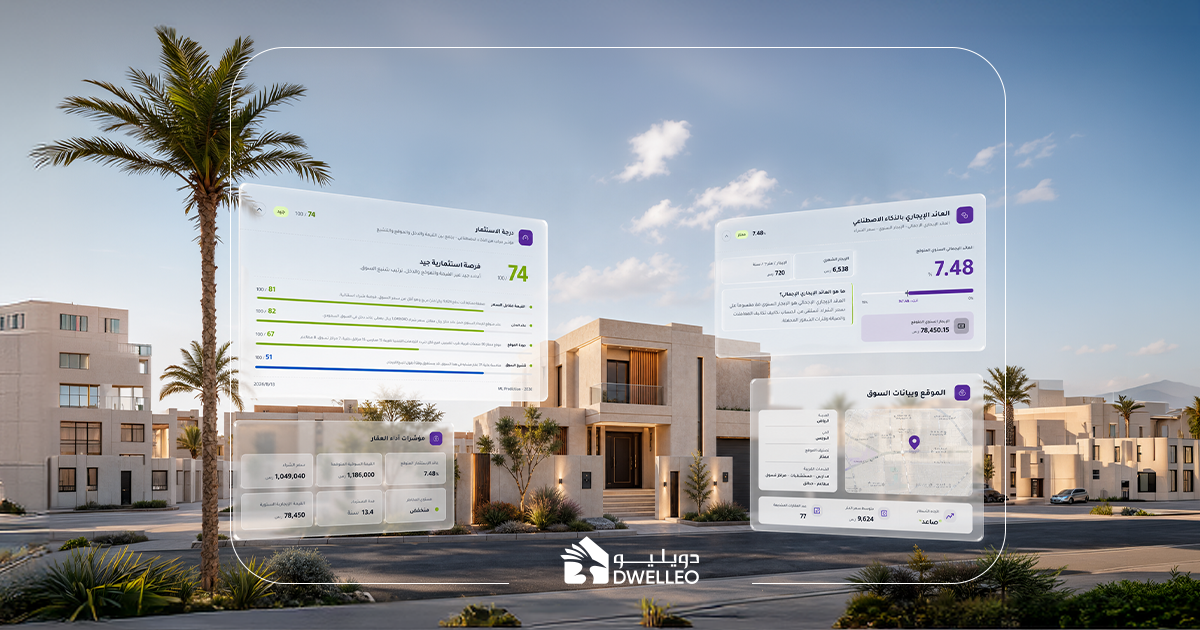
Some Dwelleo property pages currently display AI Rental Yield, including expected annual rent and gross rental yield. Dwelleo explains that gross rental yield compares annual rent with the purchase price while excluding transaction costs, maintenance, and vacancy periods. (dwelleo.sa)
5. Study Market Trends, Not Just the Current Price
The current property price is only one part of the picture. Understanding the broader market helps put the property into context.
Useful information to monitor includes:
- Property price trends.
- Demand indicators.
- Price levels across different areas.
- Supply data for comparable properties.
- Changes in the market over time.
Market Insights by Dwelleo can help users understand the market through information such as price trends, demand indicators, and supply data. The current page also presents asking-price data for listed properties and information about market supply. (dwelleo.sa)
This makes it useful to evaluate a property within the context of its area and the broader market rather than viewing it as an isolated opportunity.
6. Evaluate Risk Before Focusing on Returns
Every investment involves a level of risk, and real estate is no exception.
So the question should not only be:
“How much can I make?”
It should also be:
“What could prevent me from achieving that return?”
Potential risks to consider include:
- Lower-than-expected rental demand.
- Vacancy periods.
- Higher operating or maintenance costs.
- Changes in market conditions.
- Difficulty reselling within the required timeframe.
- Actual performance differing from initial expectations.
Evaluating risk does not mean rejecting every opportunity with uncertainty. It means understanding the relationship between the expected return and the risks involved before committing capital.
7. Consider the Property’s Future Resale Potential
Liquidity is an aspect that some investors overlook when buying real estate. Unlike highly liquid assets, a property cannot always be converted into cash quickly, and the time needed to sell can vary significantly.
Before buying, consider:
- Demand for the property type.
- Potential buyer profiles.
- Market prices in the area.
- How easily the property could be marketed in the future.
- The potential time required to complete a sale.
A property should not be assumed to be easy to sell simply because its price appears attractive. Liquidity depends on market conditions, property type, demand, and pricing.
8. Do Not Rely on a Single Metric When Comparing Properties
One property may have a competitive price, another may offer stronger rental income, while a third may benefit from different levels of local demand.
A broader comparison should consider:
- Price relative to the market.
- Expected return.
- Rental yield.
- Property location.
- Local demand.
- Market trends.
- Expected liquidity.
- Investment risks.
Combining these factors helps investors evaluate opportunities more comprehensively instead of selecting a property based on a single advantage.
How Can Investment Score Help Compare Properties?
When an investor is evaluating several opportunities, a standardized indicator can make it easier to review properties quickly.
Investment Score appears on some Dwelleo property pages as a score from 0 to 100, based on multiple factors such as value, income, location, and market saturation. (dwelleo.sa)
The score can be used as an additional reference when comparing properties, but it should not replace a broader evaluation of the property's details, market conditions, expected return, and risk.
In other words, the goal is not simply to find the highest score, but to understand why the property received that score and which factors contributed to it.
How Can Dwelleo Help You Choose an Investment Property?
Investors can use the indicators and tools available on some Dwelleo property pages to build a more complete picture of an investment opportunity.
These include:
- Investment Score: A score from 0 to 100 that helps assess factors such as value, income, location, and market saturation. (dwelleo.sa)
- AI Rental Yield: Provides estimated gross rental yield and expected annual rent for some properties. (dwelleo.sa)
- AI Price Prediction: Helps compare the asking price with an AI-supported price assessment. (dwelleo.sa)
- Market Insights: Helps users understand market data, price trends, demand indicators, and supply information. (dwelleo.sa)
This allows investors to move beyond the question:
“Do I like this property?”
and ask more investment-focused questions:
Is the price reasonable? What return can I expect? What does the market look like? And how does this opportunity compare with others?
You can explore properties on Dwelleo and use the available indicators to compare opportunities more clearly.
What Is the Most Important Factor When Buying an Investment Property?
There is no single factor that is enough to make an investment decision. It is important to consider the property's price, location, expected return, demand, expenses, risks, and market conditions together based on your investment objective.
How Do I Know if a Property Is Priced Right for Investment?
Start by comparing the property's price with similar properties and market price levels, while considering its location, size, type, condition, and features. You can then relate the price to the expected return to determine whether the opportunity fits your investment objectives.
How Do I Compare Two Investment Properties?
Use the same criteria for both properties, such as total investment cost, expected return, rental income, location, market conditions, risk, and liquidity. Indicators such as Investment Score and AI Rental Yield can also provide additional context when comparing opportunities.
Does a Higher Return Mean a Property Is a Better Investment?
Not necessarily. Returns should be considered alongside price, risk, occupancy, liquidity, and market conditions. A higher figure alone does not mean the property is suitable for every investor.
Conclusion
Choosing the right investment property is not about price alone, and it is not about return alone.
A stronger investment evaluation starts with defining your objective, then analyzing the property's location, price, rental yield, market conditions, risks, and liquidity before bringing these factors together.
Indicators such as Investment Score, AI Rental Yield, AI Price Prediction, and Market Insights can support this process, while investors should continue to evaluate the property's underlying details and market conditions before making a decision. (dwelleo.sa)